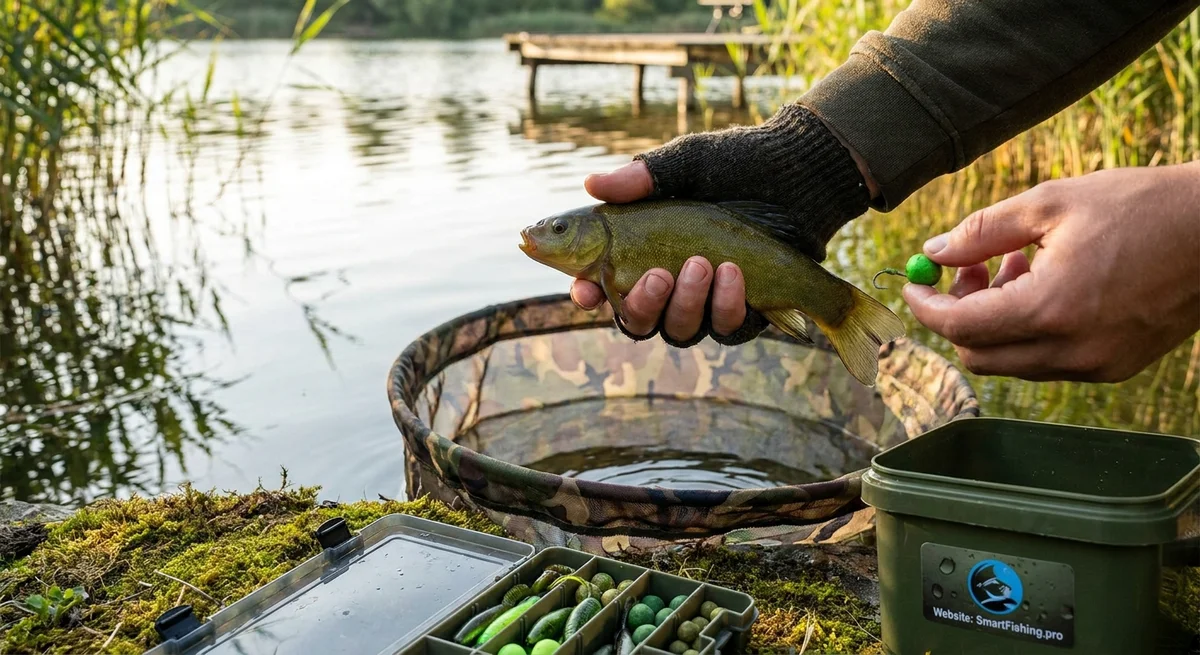
Color and Visual Cues: Do Green Tench Prefer Green Baits?
Introduction
Fishing for tench (a greenish freshwater fish) raises the question: does a green fish really want a green bait? To answer this, we look at how fish see color and how light behaves in water. Fish have eyes with special cells (cones and rods) that let them see colors and brightness. Many fish can see into ultraviolet (UV) or blue ranges that humans can’t (www.sciencedirect.com) (pmc.ncbi.nlm.nih.gov). In clear summer sunlight (like in June), the full spectrum of light (from UV through red) is available, but water changes that. Underwater, red light is absorbed very quickly – over 100 times faster than blue (water.lsbu.ac.uk). This means a bright red float or bait may appear gray or black to a fish just a few feet down. Instead, green and blue light travel farther, so fish often see blues and greens best in deeper or stained water (water.lsbu.ac.uk) (www.fishing-v.ru). In fact, when light gets dim (like at dusk or in heavy algae), fish eyes shift to see more blue-green and less red-orange (www.fishing-v.ru).
Tench live in ponds and lakes that often have green algae or brown tannins, so their world can look very green-brown. To figure out good bait colors, we combine fish vision research with how water and clarity affect visibility. We also suggest simple experiments: for example, put out two identical baits or feeders (only color differs) and count which draws more bites. That way we learn if tench really prefer green or respond to other cues.
Fish Vision and Color
Fish eyes have two main cell types: rod cells for light/dark vision, and cone cells for color. Like humans, many fish are trichromatic – they have cones tuned to three parts of the spectrum (often UV/violet, blue, and green) (www.sciencedirect.com) (pmc.ncbi.nlm.nih.gov). For example, a study of carp (a close relative of tench) found cones peaking around 377–380 nm in the ultraviolet, as well as peaks in green-blue (www.sciencedirect.com). Largemouth bass (another freshwater fish) has one cone peaking near 535 nm (green light) and another near 614 nm (orange-red) (experts.illinois.edu). The red-sensitive cone at 614 nm explains why bass can see red things better than many fish; in experiments, bass could distinguish red from gray even when they could not tell apart yellow-green versus white (experts.illinois.edu).
In general, many freshwater fish see best in the green-blue portion of the spectrum and may be very sensitive to UV light, but they often have weaker sensitivity to long red wavelengths (especially deeper down). Since tench are related to carp and often live in murky waters, it is reasonable to think tench have strong green/blue/UV vision (like carp) and possibly some orange/red sensitivity if in shallow water (www.sciencedirect.com) (experts.illinois.edu). This means colors like green, blue, yellow-green, and maybe UV-fluorescent hues are very visible to them, while deep red would fade to black except very near the surface.
Underwater Light and Color
Water itself changes what colors penetrate. Pure water absorbs red light far more than blue or green (water.lsbu.ac.uk). A classic result is that red wavelengths are reduced by 90% within a few meters of clear water, while blue-green light remains. So, even on a bright June day, a red balsa wood float will look gray-green underwater beyond a foot or two (water.lsbu.ac.uk). Green and blue light penetrate deeper, and algae in the water actually scatter green light. For example, when lake water has lots of green algae, the downwelling light tends to be strongest around 450–500 nm (blue-green) (pmc.ncbi.nlm.nih.gov). In contrast, water with brown tannins (like tea) tends to favor longer green-yellow wavelengths (pmc.ncbi.nlm.nih.gov).
In one global review, Karen Carleton notes that fish have adapted to these differences: “Blue oceans foster shorter-wavelength color vision systems than green lakes, where longer-wavelength sensitivities predominate” (pmc.ncbi.nlm.nih.gov). Put simply, fish in clear blue water may rely on UV/blue cones, whereas fish in green or tannin-stained waters build in greener or slightly red sensitivity. Lake Ecology studies also note that in freshwater (often yellow-green due to organic matter), blue wavelengths disappear within 1–3 m, leaving a greenish spectrum (water.lsbu.ac.uk) (water.lsbu.ac.uk).
Key takeaway: Red and orange colors fade quickly underwater, so greenish-blue and UV may stand out more. In clear blackwater (like peat-stained ponds), oranges shift to deeper green. In sandy clear water, blue-green dominates. This suggests any experiment or bait choice must consider the actual water color. We’ll use these ideas: green bait might blend in a green lake or brackish pond, whereas a fluorescent or contrasting color might “pop” against that green background.
Water Clarity, Algae and Turbidity
Water can also have suspended stuff (turbidity) that affects how light and color travel. There are two common types: sediment turbidity (brown mud) and algal turbidity (green plankton). A recent lab study on walleye and minnows showed that green algal turbidity actually impaired vision more quickly than brown turbidity (academic.oup.com). In that study, fish lost sight of a moving pattern at about 40 NTU (Nephelometric Turbidity Units) with green algae, but they could see past 80–100 NTU when the particles were just sediment (academic.oup.com). In other words, the green-algae water (even at lower NTU) was harder to see through than the brownish water.
This matters for bait: in green algae water, even colored baits may appear dull. Fish in green water might be able to see “bright” or reflective colors better than muted ones, simply because overall visibility is low. Consistent with this, a fishing experiment with rainbow trout found that in clear water the trout hit natural-colored lures (brown, dark green) most, but in very turbid water those dark lures were nearly ignored (agris.fao.org). In the same study, trout liked pink, orange, and fluorescent baits at similar rates whether the water was clear or murky (agris.fao.org). In short, bright, highly visible colors win when water is dirty.
Applying to tench: if June water is clear and sunlit, tench might respond to subtle green/brown colors typical of natural food. But if green algae bloom or summer turbidity comes in, a bright or UV-sticky bait might be more detectable. We should design experiments that compare bait color under both conditions.
Designing Color Experiments
To test color preferences, set up side-by-side trials. For example:
-
Bait color test: Rig two identical rods with identical rigs and scents, but use different hookbait colors (e.g. green micros vs pink boilie) (agris.fao.org) (dergipark.org.tr). Fish these rods alternately or with multiple anglers, and count which color draws more interest (bites or picks-ups). Repeat this in both clear-water and algae-green conditions to see if the pattern changes.
-
Feeder color test: Use the same groundbait mix but colored pellets or particles. For one feeder, tint the mix green or brown; for the other, tint it fluorescent (or bright orange). Cast back and forth between spots to fish both evenly. This tests whether tench target the feeder by noticing its color or just by scent. After many casts, compare catch or bite rates by feeder color.
-
Float color test: Floats are different (they’re mostly for us to see), but fish do notice them. One idea: use two identical rigs with differently colored floats (say one green/brown, one bright orange). Bait both with same food and fish them under similar conditions. If fish bite equally, float color didn’t matter much. If one float color consistently causes more fish to avoid or take, that’s telling.
-
Contrast test: Try baits with the same hue but different contrast patterns. For example, a dark green bait vs a light green bait, or a lure painted in green with black spots vs plain green. This helps determine if tench react to the difference in brightness or pattern rather than hue itself.
-
UV reflectance test: Many fishing lures use UV-reflective paints (invisible to us but bright to fish) (www.sciencedirect.com). You could take a bait or feeder part and paint it with UV-reactive paint on one try, and a normal paint on another, then compare fish response (for example under a UV lamp you’d see a glow only on the UV-painted one). If tench have UV cones (likely, as carp do), the UV-painted bait might attract them at longer range.
In all tests, keep everything identical except the color. Fish conditions one at a time (same spot, time of day, depth). Track bites or sightings to see which lure was noticed first or more often. Over weeks or days, switch the rods/positions to rule out location bias. This systematic approach is how science infers fish color sensitivity in the wild.
Water Factors: Color, Algae and Turbidity
We must consider the water itself. A green-tinted lake (lots of algae) will absorb and scatter light differently than a clear lake. Algae blooms give the water a green filter, which might make green objects appear darker or more blended into the background. In algae, contrast is low. In one study, fish detection fell off faster in green algae water (academic.oup.com), meaning if green bait and background share hue, it might hide the bait. Conversely, a lively color (like neon yellow or pink) could render more contrast.
If the water is brown (tannins or clay), green might contrast more (brown water often makes everything seem yellowish). In brown water, many anglers find that chartreuse or orange baits show up well. The trout study supports this: in muddy water, bright orange, pink and yellow lures still got attention (agris.fao.org).
Also consider depth and light angle: In shallow water on a sunny June day, plenty of colorful light reaches the bottom (including some red). But by late evening or in deep spots, only blue-green light remains (www.fishing-v.ru). So a red float or bait will look differently at dusk than at noon. A red or orange float might look dark or olive to a fish in green water, due to limited red light.
In all cases, contrast often matters more than the actual color name. A dark object on a light background or vice versa is easy to spot. So even a green bait may be visible if it’s much lighter or darker than the surroundings. For example, a bright lime-green worm might stand out more against shady pond weeds than a deep dark-green worm.
What the Research Suggests about Color
-
Blue and Green Elements Can Be Subtle: One ocean study found fish tended to swim near blue and green buoys, while avoiding bright white or black buoys (www.sciencedirect.com). Surprisingly, fish preferred the less visible blue/green objects. This hints that fish sometimes treat blue/green as “normal background” and avoid obvious contrast (www.sciencedirect.com). However, that was in clear blue saltwater with schooling fish. Tench might react differently, but it suggests green-green camouflage might not always draw them in.
-
Tench and Carp Lure Preferences: A field test with colored nets in a lake (identifying “preferred color”) found that tench and carp were mostly caught by red, yellow, brown or blue nets, but rarely in light-green nets (dergipark.org.tr). In fact, the usual green nets were the least effective. This implies tench did not simply prefer green – they often entered bright-colored nets. If nets (large stationary “bait”) attract fish, perhaps similarly bright bait could do the same. Conversely, a green lure may blend in and attract less notice.
-
Red Hooks in Muddy Water: (From a Russian source) It is claimed that in very murky water or overcast light, red-colored hooks can increase bite rates by 30–40% compared to black or gold hooks. This matches a common angling tip: red stands out in low light. However, scientifically red is quickly lost in water – this effect may come from the hook appearing black (since red is gone) but perhaps small fish or worms on it reflecting differently. We can’t confirm or cite that directly, but anecdotally many anglers use red (or magenta) artificial baits effectively in dusk/mud.
-
Color Blind Spots: Bass vision experiments showed they could not distinguish certain colors: e.g. chartreuse (yellow-green) looked like white, and green looked like blue (experts.illinois.edu). If tench have similar insensitivities, some color matches might not be meaningful to them. For example, a green lure under certain light might just appear as a generic light or dark object.
-
UV Visibility: Carp (and likely tench) can see ultraviolet (around 370–380 nm) (www.sciencedirect.com). UV doesn’t show to us but makes certain dyes and threads glow vividly to fish. Many anglers now use UV-reactive threads on flies or fluorescent baits for species known to have UV cones. Including UV-reflective material on tench bait (for example, a painted bead or a UV-fly under a worm bait) could make the bait pop in the fish’s vision.
Designing Useful Experiments
Based on the above, here is how you might set up useful trials:
-
Controlled bait choice: Make two rigs exactly alike except for bait color (say, one with green boilie, one with orange or white). Fish them under the same conditions (same day, same spot, same water). Use multiple repeats (many casts or days) to get enough bites on each to compare. Also try in different water clarity. If one color consistently out-fishes the other, that color is more visible/ attractive under those conditions.
-
Contrast tests: Don’t only compare color; compare contrast. For instance, use two similarly hued baits that differ in brightness (dark green vs light green), or a multi-colored pattern vs a solid color. This tests if tench key into silhouettes and outlines rather than hue. Video studies show many predatory fish strike at high-contrast shapes more than at specific colors.
-
Float observation: Use floats of different colors and observe fish behavior. This could be done by filming from above or side (if water clarity allows). See if tench swim up to inspect one float more than another. You might even attach a dangling lure and watch which fish come close. This can tell you if certain float colors (like bright versus dull) seem to alarm or attract them.
-
Feeder visibility: Set feeders of different colors (or with colored lids) at fixed spots and monitor fish arrival. This could be filmed or fished passively. If fish circle one feeder color more, it indicates its increased visibility. Alternatively, an underwater camera can show if tench examine the feeder before bait is released.
-
UV test: Under normal sunlight, shine a UV flashlight on the bait along with your fishing. A UV-reactive bait (like a fluorescent fly or UV-painted sinker) will glow intensely for the fish. Compare catch rates with and without a UV-active component. Since people can’t see it, you can do a blind test. Dr. Hawryshyn’s carp study supports that UV vision is real in these fish (www.sciencedirect.com).
In all cases, document every condition: time of day, depth, exact bait used, etc. That way you separate color effects from other factors (some baits also differ in scent or movement). Even simple experiments like these generate valuable insight and can guide your tackle choices.
Choosing Colors in Practice
From both science and angling lore, here are actionable tips for five typical fishing items under June conditions:
-
Floats: Anglers need to see their float, so bright tips (neon orange, chartreuse) are common. However, to avoid spooking tench, consider a dual-color float: bright on top (so you see bites) and subdued body (olive green, brown) below water (water.lsbu.ac.uk). This way the fish sees mostly the dull side (blending in), while we see the flashy part. If using a fixed-poise float, paint the section above water a vivid color and the underwater portion a neutral green-brown.
-
Feeders: Feeders are often metallic cages or cups. Be aware that a bright-colored feeder might draw fish from farther out by contrast. In stained or low-light water, a fluorescent (red, orange, mustard yellow) painted feeder could attract tench (agris.fao.org) (dergipark.org.tr). In clear water, a feeder that blends (matte brown/green) might look more natural. For example, commercial feeders often come in dull green or brown for this reason. If you find tench aren't responding to your feeder, try attaching a small piece of fluorescent tape or UV-reflective sticker to it. This small patch might act like a beacon.
-
Hookbaits (natural & artificial):
- Natural baits: Brown or yellow (corn, hemp, bread pastes) usually look quite natural and are effective in clear water. Maggots dyed orange or pink offer medium contrast. Green maggots (if available) may still look natural near weeds. In contrast, white or glow-baits are often best at night or in dirty water (they pop out).
- Artificial baits: Bright or UV-active baits can get bites in murky conditions. For example, bright pink plastic worms or chartreuse silicone grubs may appear more fishy under green light. PVA sticks or boilies with UV pigments (many are sold as “UV-active”) are also worth trying. Remember the trout study: in low visibility, pink/orange outperformed earth tones (agris.fao.org).
- Black or dark baits: Surprisingly, dark colors (black, dark brown) can silhouette well in clear water, especially if viewed against a bright sky from below. Pike and tench sometimes hit dark lures at dawn/dusk because that creates a strong silhouette. But don’t assume black always wins; black is like any dark object – it stands out if background is light, but can vanish on a dark weed background.
-
Hook and rig details: Even hook color can matter. Red hooks are popular because under water they often turn into a silvery or dark contrast (themselves), depending on light (experts.illinois.edu). In fact, one report noted red hooks can increase bites in muddy water. If you use a green hookeye or green line near the hook, it can hide that area (sometimes useful if fish shy of shiny hooks). Conversely, a bead or tubing in a bright contrasting color (pink, yellow) just above the hook can force tench to look. Some rigs use white or orange plastic attractors just above the hook to mimic spawn or prey; that’s a contrast trick too.
-
Water color match: Always adjust to the specific lake. If the water is tea-colored (brown), green bait might actually stand out more than red (because red is filtered out). If the water is olive-green algae, a hot pink or orange bait is more visible. You can hold colored samples at depth during a normal day and see how they look (some angler trick). Outdoors, note which colors still catch your eye underwater – those will be easier for the fish too.
Conclusion
Green is not always best. Even though tench look green to us, that doesn’t mean green bait is ideal. Fish vision research shows tench likely see well in green-blue-UV light (www.sciencedirect.com) (experts.illinois.edu), but contrast is king in real conditions. In clear summer water, natural browns and greens can work (matching weeds and substrate). In bright sun they look normal to tench. But if the water is overcast, muddy, or algae-rich, green lures may blend in too much. In murky or low light, bright or fluorescent baits (pink, orange, yellow, UV-glow) often produce better strikes (agris.fao.org) (dergipark.org.tr).
Actionable gear choices: For floats, use highly-visible tips but keep the underwater part camouflaged. For feeders, consider a dash of high-visibility color (or light-reflective tape) if fishing a stained lake; otherwise earth tones are fine. For hookbaits, carry a range: natural-tinted ones (brown, green, yellow) for normal clear water, and hot/pastel/UV ones for dull or colored water. If in doubt, start with natural colors on sunny outings and switch to brighter plugs when the water or light becomes poor. By matching your tackle to the fish’s vision and the water’s light, you’ll increase your chances – whether the tench are drawn to camouflage or contrast, you’ll be prepared to satisfy them.
References: Fish vision studies and experiments on color in water reveal the above trends (www.sciencedirect.com) (water.lsbu.ac.uk) (agris.fao.org) (dergipark.org.tr) (academic.oup.com) (experts.illinois.edu).
Get New Fishing Research & Podcast Episodes
Subscribe to receive new research updates and podcast episodes about freshwater fishing, lake fishing, fish species, seasonal patterns, fishing tactics, bait, lures, rigs, and practical angling strategy.