Weather and Pressure: How High Pressure, Storm Fronts, and Rain Affect June Tench
Weather and Pressure: How High Pressure, Storm Fronts, and Rain Affect June Tench
Introduction: Weather deeply affects how and where tench (a warm-water carp species) feed. Anglers long check barometers and forecasts before heading out. Barometric pressure and storms subtly change water chemistry and fish behavior. We’ll look at scientific studies and veteran anglers’ notes to explain what happens before, during, and after summer weather events, and how you can plan your fishing.
Tench are bottom-feeders common in lakes and slow rivers. In June, water is warm and tench become more active. Fish can sense pressure changes through their swim bladders, so when the air pressure falls or rises slowly, they may change depth or appetite (www.rbc.ua) (researchonline.jcu.edu.au). In fact, a lab study found that rising pressure temporarily ramped up activity in gobies before they settled back to normal (agris.fao.org). Real-world fishing data, however, often show no simple pattern. For example, a fisheries biologist found no clear correlation between barometer reading and catch rate in stocked ponds (www.bassresource.com). In practice, anglers note that fish often bite best when pressure is steady or gently changing, and that rapid swings (e.g. an incoming storm front) usually slow feeding for a while (www.rbc.ua) (www.simfisch.de).
Barometric Pressure and Fish Behavior: Barometric pressure is essentially the weight of the air above us. When a storm front approaches, air pressure tends to fall; when weather clears, pressure rises. Fish “feel” this change. Many anglers have observed that predator fish (like pike and perch) often feed hard when pressure falls slowly – as if “bulking up” before bad weather (www.rbc.ua). For instance, an angling report notes that when a cold front’s prelude drops pressure, pike and zander “wake up with a voracious appetite” (www.rbc.ua). Likewise, examining bass behavior shows baitfish and game fish tend to move deeper when the barometer is low (weather.com) (weather.com), so they may slow down feeding in shallow water during a heavy front.
By contrast, tench belong to the carp family, which generally tolerates a wide pressure range. A fishing guide notes that carp, crucian carp and tench do well over “755–765 mmHg,” so they often bite under many conditions (www.rbc.ua). In practice, this means tench may remain willing to feed when other fish quit. In general: stable pressure (high or low) or a slow rise/fall is good, while quick big jumps (like a sudden storm front) often shut feeding for a day or two (www.rbc.ua) (www.simfisch.de). Drastic changes can even stress fish. For example, in sharks scientists observed juveniles moving to deeper water ahead of a tropical storm (triggered by the falling pressure) (researchonline.jcu.edu.au). We might expect freshwater tench to seek slightly cooler or deeper spots during a storm.
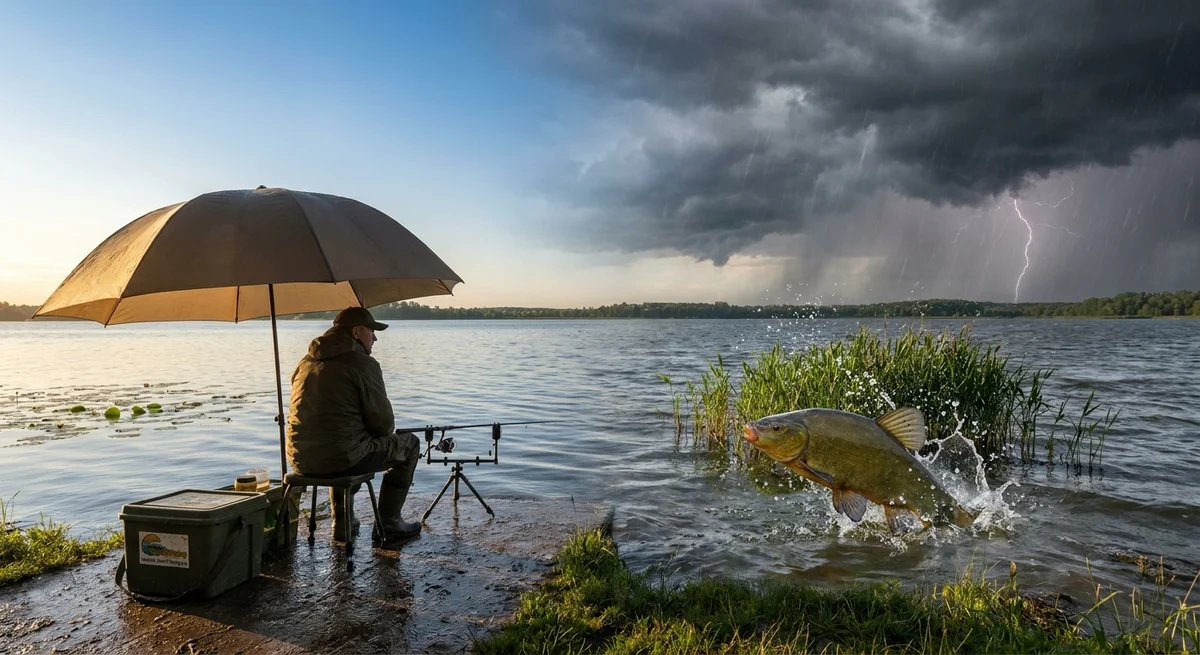
Storm Fronts – Before, During, After: When a storm front begins, the barometer starts dropping. Many anglers report a pre-front spike in feeding – fish “sense” the change and bite actively for a short time (www.rbc.ua). Then, as the front (rain and often wind) arrives, fish can become sluggish or scatter. The heavy rain and wind churn the water and cool the surface. In June this can be good or bad: gentle rains and wind mix oxygen and food, but heavy storms can muddy the water or even force fish deeper. One angling test found that predator bite rates were low under steady high pressure before a storm, but greatly increased right after a summer downpour (www.hechtundbarsch.ch). In other words, while feed often falls off during a storm itself, it tends to pick up strongly just after.
After the storm passes (pressure rising again), fish often emerge hungry. Fresh rain flushes nutrients, insects and small prey into the water (and often into inlets and edges). For example, debris, detritus and insects washed from banks and streams create a “feast” that draws tench and other fish (www.simfisch.de) (www.discoverboating.com). A boating resource article notes: “Rain can spark feeding activity because it washes food into the water and creates current that groups bait in easy-to-find places (www.discoverboating.com).” In practical terms, fish often hold near inlets, creek mouths, and flooded edges after a rainfall, where the water is richer with food (www.simfisch.de) (www.discoverboating.com).
Rain and Oxygen – The Good and Bad: Rain changes water chemistry in two main ways: it wets the surface and can add cooler fresh water. Gentle rain and wind sweep oxygen into the lake. Every splash and wave lets the air’s oxygen diffuse into the water, which fish enjoy – especially on hot summer days. An angling guide explains that during rain and waves, the water surface “overturns,” bringing oxygen down and equalizing the lake. This extra oxygen “is a real treat in summer”: fish “take a deep breath” and grow more active (www.simfisch.de). Dr. Claude Boyd (a pond-water scientist) similarly notes that rain alone has a very small oxygenating effect, but wind-driven waves have a much larger impact on oxygen levels (www.bassresource.com). So on a breezy, drizzly day, tench can feed vigorously because they have more oxygen and food available.
However, heavy rain has downsides. Strong runoff can muddy the water, making sight-feeding harder. If rain is cold, shallow areas cool off and fish may briefly retreat to warmer depths (www.discoverboating.com). Prolonged rainfall can also cause groundwater flows (called quellwater) to enter, which often carries iron. When iron-rich water hits oxygen, it chemically consumes oxygen, sometimes starving fish (www.wdodelta.nl). In general, very heavy, warm-season rainstorms can temporarily stress fish: anglers have even seen fish gulping air during floods when oxygen plummets. Thus, moderate rain and wind usually boosts activity, while continual downpours may demand caution. Just after heavy rain, focus on cleaner edges: fish often feed right at the boundary between muddy runoff and clear water (www.discoverboating.com).
Wind Mixing and Stratification: Lakes often form thermal layers in summer – a warm, oxygen-rich upper layer and a cool, low-oxygen bottom layer (www.waterontheweb.org). When the lake is calm under high pressure, the bottom layer can become almost oxygen-free. Tench normally tolerate low oxygen (they spawn in dense weeds where oxygen varies wildly (www.anglingtimes.co.uk)), but other fish won’t, and even tench will prefer higher oxygen. Wind matters a lot. A scientific study of lake turnover showed that a strong wind event deepened the oxygenated layer by about 1.5 m, mixing some cool water up (repository.library.noaa.gov). In general, winds and waves break stratification, pushing oxygen deeper and often preventing “stagnant” zones. Pond experts note that after wind/mixing events, oxygen levels tend to even out, which improves fish metabolism and feeding activity (www.simfisch.de) (repository.library.noaa.gov).
On the other hand, extremely powerful storms can mix up cold, oxygen-poor water from the depths and actually drop overall oxygen. Dr. Boyd describes how a heavy rain+wind mixing (a “turnover”) can dilute surface oxygen with low-oxygen bottom water, sometimes even causing fish kills (www.bassresource.com). Fortunately, in most June conditions a good breeze will simply stir the lake beneficially: more oxygen at all levels means tench can hunt and digest aggressively (www.waterontheweb.org) (www.bassresource.com).
Tench Behavior in June: By June the water is warming and tench are feeding hard to prepare for spawning. (Tench typically spawn in late June when temperatures are highest (www.anglingtimes.co.uk).) Anglers often fire baits at tench on well-oxygenated warm days. Given their tolerance for low oxygen (www.anglingtimes.co.uk), tench can remain active when others slow. They roam the shallows for insects and worms, and like midday warmth. However, they do respond to changing conditions: on hot calm afternoons they may hug weed beds or deeper drop-offs to avoid overheat and low oxygen. Any mixing or cooling rain may lure them up to feed.
Fishing Plan by the Forecast: How do we tie weather to a fishing session? Here are some guidelines for June tench fishing based on forecasts:
- High-pressure, settled days: Expect calm conditions and possibly sharp thermal layering. Fish the warmer edges early or late (dawn/dusk) when temperatures are comfortable. In daytime, fish might sit deeper or in weed edges. Moderate mid-pressure rise through the morning can keep fish biting steadily.
- Pressure falling (front approaching): Fish the pre-front phase. Typically, the day before a storm or on the morning of a front, bite can be good as fish feed up. However, as rain builds, the bite may briefly slow. Use this window to reach areas like deeper shelves or loitering weed edges.
- During a passing storm: Safety first (beware lightning!). If it’s just drizzly with wind, fishing can still be productive. Target edges and creek mouths where fresh rainwater enters (insects and nutrients wash in here). If the water turns very muddy, focus on clean/muddy boundaries. If a hard rain cools the shallows, try slightly deeper broken ground where tench may shelter.
- After the front (post-storm): This is often prime time. Water will have fresh oxygen and food. Fish often resume feeding with vigor after waters calm. Aim for the 1–2 days after a storm, fishing flooded margins, backwaters, and outlets. Tench will likely be in the newly enriched shallows, picking through washed-in morsels.
- Long rainy periods: If light rain continues for days, fish remain active. Strong, sustained rain can push tench into less turbid areas; look for backflows and clearer nearby water. For example, tench often appear near submerged cover once rivers flush nearby. As flow subsides, watch for renewed feeding.
- Windy days: Use the wind to your advantage – fish the windward banks or points where waves pile food. Wind usually means mixed oxygen, so tench may feed in daylight better than usual.
Conclusion: Anglers and anglers’ science agree that weather patterns offer clues for catching tench in June. While no single rule is foolproof, a consistent picture emerges: steady or slowly changing pressure with good oxygen is reliable, and transitional periods around fronts can bring bursts of feeding. Moderate rain and wind generally boost fish activity (mixing in oxygen and food), whereas stiflingly calm or extremely stormy conditions can quiet them down. By reading forecasts – noting barometric trends, front passages, and rain/wind events – you can schedule sessions for the times tench are likeliest to bite. For example, plan to fish during the lull before a predicted summer storm, and especially after the front has passed and waters settle. Even on cloudy drizzly days, don’t pack up: these can be tench-feeding days if you fish the right zones. Overall, match your timing to the weather cycle: dawn and dusk on stable, clear days; midday on mild rain-and-wind days; and the hours just before and after storm fronts. Doing so maximizes oxygen-rich, food-rich conditions when tench are most eager to feed (www.simfisch.de) (www.discoverboating.com).
SEO Tags: kayaking tags JSON array at end
Get New Fishing Research & Podcast Episodes
Subscribe to receive new research updates and podcast episodes about freshwater fishing, lake fishing, fish species, seasonal patterns, fishing tactics, bait, lures, rigs, and practical angling strategy.