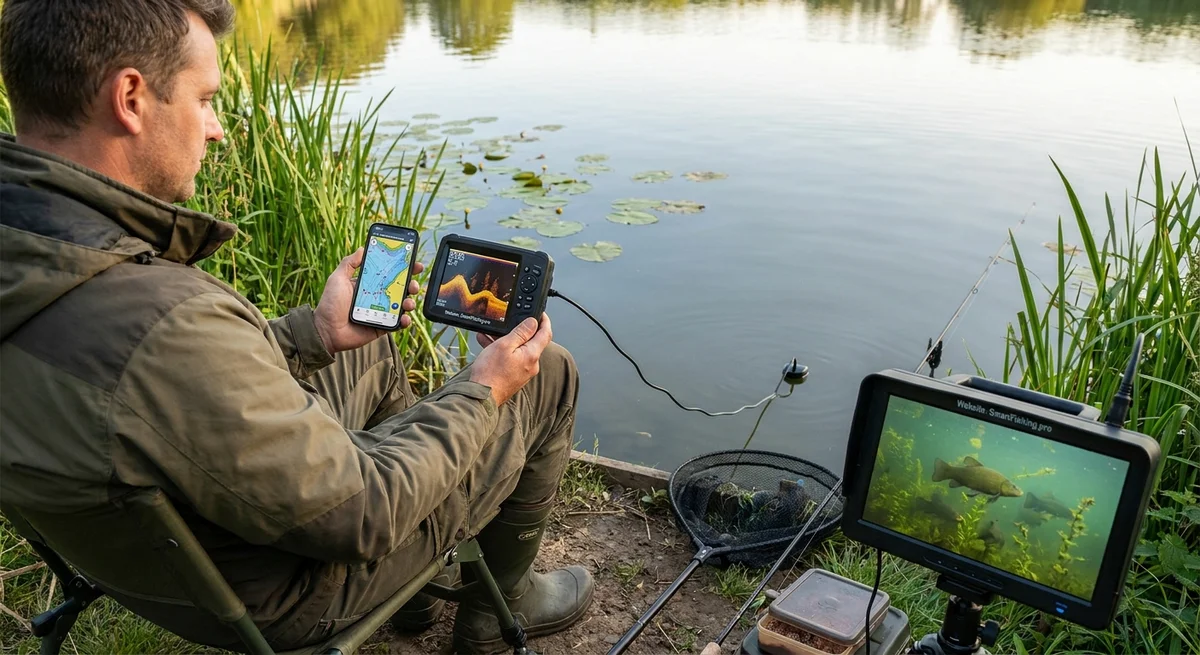
Using Tech in June Tench Fishing: Sonar, Mapping Apps, and Underwater Cameras
Introduction
Modern gadgets can help anglers find tench, a shy freshwater fish. In June, tench hide in weedy, calm waters. Tech like fishfinder sonar, mapping apps, and underwater cameras can show where tench might be, making fishing more effective. But anglers must use these tools wisely. We discuss how to map water depth and weeds, log catches with GPS, link data to weather, and compare sonar devices. We also cover fish-friendly tips and privacy when sharing info with fishing clubs.
Why Use Tech (and When to Be Careful)
Fishing tech has big benefits:
- Sonar fishfinders show depth and fish under water.
- Mapping apps (like Navionics or fishing smartphone apps) chart depth contours and mark weed beds.
- Underwater cameras let you peek at fish and plants directly.
- GPS logging keeps track of where each fish was caught.
- Weather data (air pressure, wind, temperature) often predicts fish activity (www.fishday.pro).
For example, a fishing guide notes that fish often bite when air pressure falls just before a storm (www.fishday.pro). Syncing a fishing app to local weather (or using a barometer) can tell you when tench are likely to feed.
However, we must use tech carefully. Tench prefer quiet, calm waters with weeds (canalrivertrust.org.uk) (canalrivertrust.org.uk). They do not like loud boats or crowds (canalrivertrust.org.uk). Studies show boat noise can stress fish (fish “aren’t likely to be happy” in noisy water (www.sportfishingmag.com)). So if using tech from a boat, use a quiet motor or paddle to avoid scaring tench. Likewise, if using roadside gadgets, don’t flood a little pond with too many anglers at once.
Ethically, anglers should also protect fish. For popular species, one study found that early fears of sonar overfishing were “not warranted” in many cases, especially where fish are released back (academic.oup.com). This suggests tech itself isn’t bad if we practice catch-and-release and rotate spots. Still, always follow local fishing rules (some lakes restrict electronics) and be mindful not to overfish one spot.
Mapping Depth and Weed Beds
A great use of tech is making your own lake map for June tench fishing. Here’s a simple workflow:
-
Do a sonar scan:
- Use a fishfinder on a boat or kayak, or a castable sonar device from shore.
- Move across the water and ping at many spots. Each ping gives a depth reading, and often shows weed (vegetation) under water.
- Some sonar apps or fishfinder units save the data with GPS location.
-
Create a depth map:
- Take the saved data (many sonar fishfinders let you export logs) and load it into a mapping app or software. For example, BenthoMap or Navionics’ SonarChart can turn raw sonar readings into depth contours and area maps (www.benthomap.com).
- If you don’t have special software, even plotting some points in a notebook or on Google Earth/Garmin app helps. Mark contours (shallow/medium/deep). This shows holes or drop-offs where tench might gather.
-
Map weeds:
- During your sonar run, note weed shoals. The sonar screen often shows a fuzzy mass for vegetation. You can mark it on the map same as depth.
- For a closer look, use a small underwater camera near suspected areas. One study found “most fish did not react strongly to the camera” (repository.library.noaa.gov), so a brief peek is usually fine. Drop the camera near weeds to count plants or fish present.
-
Combine information:
Once you have water depths and weed locations, your map highlights tench hotspots (weed edges or deep-sloped weed lines). You can share this map with trusted club mates or keep it for personal use. Clear, colored charts (for example, green areas = weeds, blue lines = contour lines) make it easy to spot where to cast.
Logging Bites with GPS and Checking Weather
Keep a catch log to learn what works best. For each bite or catch, note the GPS location, time, bait used, and conditions. There are several ways:
- Smartphone apps: Many fishing apps (like Fishbrain, Fishidy, etc.) let you tap a map to mark a catch. If you don’t have an app, use a note app or diary with a simple map sketch.
- GPS & markers: If your fishfinder or phone has GPS, drop a pin each time a fish bites or is landed. Over time this creates a pattern of “bites per spot.”
- Weather sync: Always note weather factors. Linking your logs to weather data is helpful. For example, the fishing guide FishDay explains that fish often feed heavily 2–12 hours before a weather front, as falling pressure triggers a feeding frenzy (www.fishday.pro). So record air pressure or cloudy vs. sunny. Apps like Windy or even your fishing app often include wind, barometer, and forecast. Over many trips, you may see tench biting only under certain weather patterns.
By matching where and when bites occur, you build your own fishing database. Say you notice tench biting late afternoon on cloudy days when pressure dropped. That insight helps you plan the next trips. This data-driven approach is very actionable: it tells you where to fish (per your depth/weed map) and when to fish (per weather).
Castable vs. Boat-Mounted Sonar (and Noise)
Castable sonar units (like a Deeper or Garmin castable finder) are portable devices you toss into the water. They send depth information to your phone. Boat-mounted sonar uses a transducer on a boat hull to scan beneath while moving. Both have pros and cons:
- Coverage: Boat sonar can scan under the boat constantly and cover large areas quickly. A castable sonar is used from shore or a stationary boat spot-by-spot.
- Depth: Boat sonar (often with lower frequencies) can reach deeper. Castable units usually use higher frequencies (around 200 kHz) so they work well to moderate depths (and give finer detail).
- Noise footprint: Both castable and boat sonar emit sound pulses, but at ultrasonic frequencies fish cannot hear. For example, many fish hear only up to ~1,000 Hz (www.justfishkeeping.com), while sonar pulses are tens of kHz or above (www.furuno.com). Thus tench don’t hear the pings. The main noise issue is boat engines: big motors rumble at low frequencies that fish do hear. In one report, a researcher noted “boats create an incredible amount of noise… When background noise goes up, fish aren’t likely to be happy” (www.sportfishingmag.com). Another noted that any sudden underwater noise (like a boat hull slapping) “can repulse fish” (www.sportfishingmag.com).
In short, boat motors and propeller sounds are more disturbing to tench than the quiet pings of a sonar. So if fishing from a boat, try to use a quiet outboard motor, an electric trolling motor, or paddle to minimize noise. A castable sonar is effectively silent when not pinging and since it’s small, it adds almost no noise. When choosing sonar, remember the frequency: many recreational finders use 50 kHz and 200 kHz (www.furuno.com). These high frequencies reveal fish and weeds well, and remain above what tench can detect by ear (www.justfishkeeping.com).
Privacy and Sharing Data with Your Club
High-tech fishing often means digital data. It’s important to handle that data wisely:
-
Keep spots secret unless needed: Anglers treasure their “honey holes.” A fishing app reminds users that “the fishing spot is the most sensible information, and that we most protect it at all cost” (www.fishfriender.com). When you log a catch on an app, use privacy settings: for example, FishFriender defaults to making the exact location private. Other anglers will only see a general area (like the county) instead of GPS coordinates (www.fishfriender.com). Use similar settings: mark your best spots private, or only share with trusted club members.
-
Share wisely with your club: Clubs may want to collect data (like depth maps or catch rates) to benefit everyone. It’s fine to contribute, but do it carefully. For example, if you collect your sonar depth map, maybe share a combined map (no personal catch data) with the club. Or submit catch data anonymously. If your club has an online forum, make sure location tags in photos or logs are turned off.
-
Use secure platforms: If you use online or app services, check privacy controls. Fishbox, Carpod, Fishbrain and others often have options for private logs. For example, FishFriender lets you choose spot visibility: “public” (everyone sees pin), “friends” (only buddies see it), or “private” (www.fishfriender.com). By default it hides your exact spot. Always leave sensitive catches (‘private’) unless you deliberately want to show friends.
-
General online caution: Don’t post live location updates or share precise GPS on a public forum. Instead of “Caught a 3lb tench at 37°48.123N, 122°01.321W,” just say “caught a nice tench on our local reservoir.” This keeps fish advice helpful without pinpointing the exact rock pile to others.
By following privacy settings and club agreements, you help the whole club fish more, without giving away strategic locations. Always ask before posting location data from club waters.
Conclusion
Modern tech – sonar fishfinders, mapping apps, GPS, and cameras – can make June tench fishing more productive and fun. By mapping depth and weed beds, noting bites on a GPS log, and considering weather trends (www.fishday.pro), you fish smarter. On the other hand, tench are shy and easily stressed (canalrivertrust.org.uk) (canalrivertrust.org.uk). Using quiet methods (like paddling or casting sonar) and releasing fish gently helps protect them. Research even suggests that using sonar doesn’t automatically harm fish populations if it’s done fairly (academic.oup.com). Finally, respect data privacy by keeping precise spots secret or sharing only with friends (www.fishfriender.com) (www.fishfriender.com). This balance of technology and ethics lets you catch more tench while keeping the waters healthy for future fishing.
**`
Get New Fishing Research & Podcast Episodes
Subscribe to receive new research updates and podcast episodes about freshwater fishing, lake fishing, fish species, seasonal patterns, fishing tactics, bait, lures, rigs, and practical angling strategy.